The Amazing Life of Kushalisious Maximus
by Daniel D. Squires Jr. · Epic Fantasy
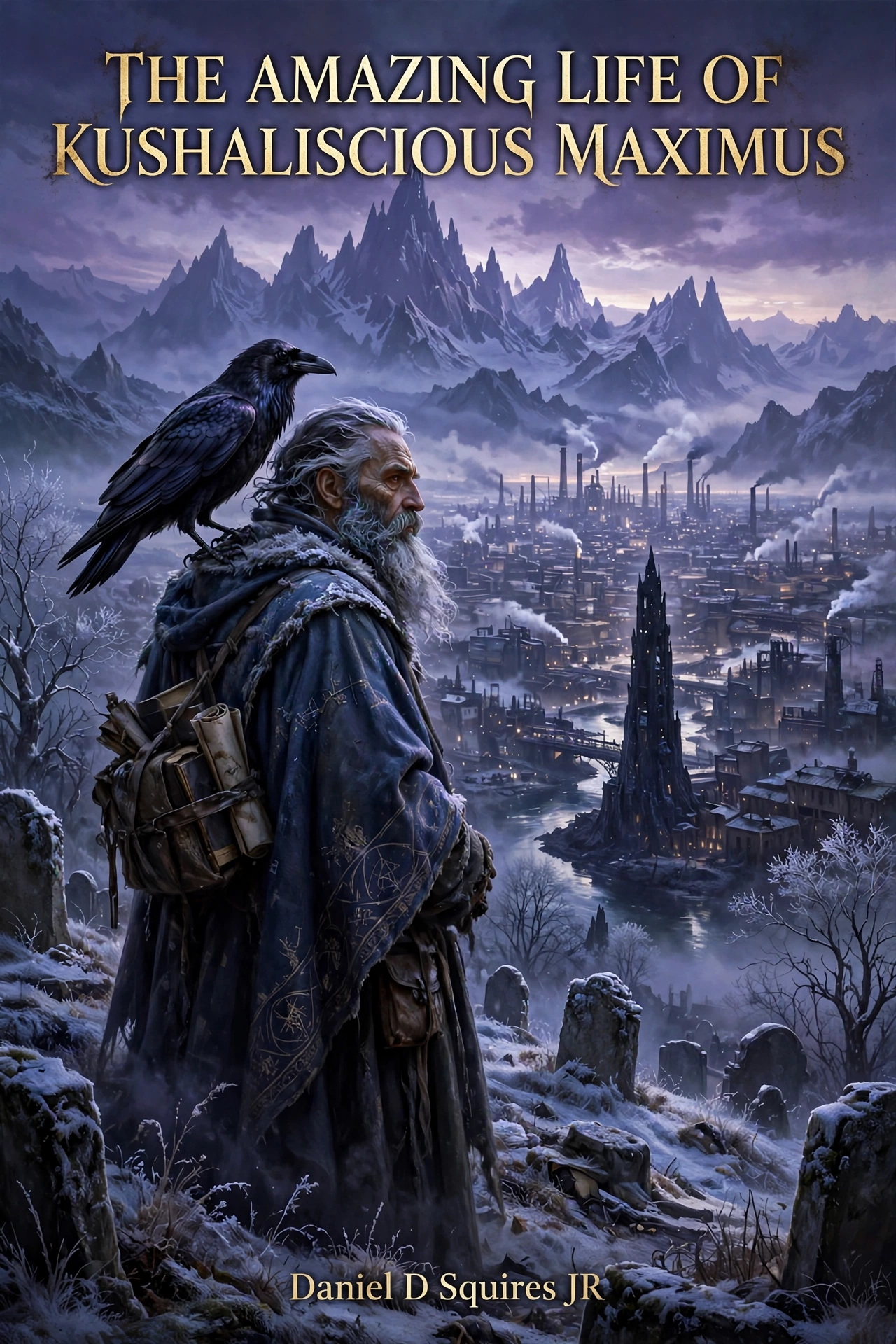
Chapter One: The Weight of Returning The wind that greeted Kushalisious Maximus as he emerged from the crumbling crypt was not the same wind he had left behind. Or perhaps it was he who had changed, and the wind, indifferent and eternal, simply revealed itself anew to a man who had finally learned how to listen. He stood at the threshold of the forgotten entrance, half-concealed by a tangle of frost-blackened ivy, and inhaled the air of Aethelgard for the first time in what his body insisted had been forty-seven days. His lantern, long since extinguished, hung uselessly from his belt. His leathers were stiff with dried mud and the salt of his own sweat. His beard, once trimmed with a scholar’s fastidiousness, had grown wild and streaked with a silver that had not been there when he descended. And in his mind — oh, in his mind — there churned an ocean that no shore could contain. Corvus shifted on his shoulder, the raven’s single remaining foot gripping the leather with the patient irritation of a creature who had long ago accepted the indignities of his keeper. The bird made a sound that was not quite a caw, not quite a sigh, but something between the two — a noise Kushalisious had heard perhaps three times in the decade they had shared a tower, and never before in such a tone of weary recognition. “I know,” Kushalisious murmured. “I feel it too.” Above him, the bruised purple sky of Aethelgard was beginning to pale toward dawn. The twin moons had set hours ago, their alignment long broken, and now a thin band of grey light crept along the eastern peaks of the Dragon’s Tooth Mountains. The city lay below him in a hollow of shadow, its chimneys exhaling their perpetual offerings of soot and steam, its forges already roaring despite the early hour. Aethelgard never truly slept. The council had decreed, three generations past, that idleness was the seed of poverty, and so the bellows worked through the night, and the hammers fell in shifts that overlapped like the scales of some great industrial serpent. Kushalisious had once admired this. He had once written, in a treatise submitted to the council in his thirty-fourth year, that Aethelgard’s tireless industry was a triumph of human will over the cruelty of its mountain prison. He remembered the phrase precisely — *a triumph of human will* — and the memory now made him want to weep. He began the long descent toward the city. The path from the crypt wound through a graveyard so old that its stones had forgotten their own names. Lichens had eaten the carvings down to suggestions, and the iron fences that had once enclosed family plots had rusted into lacework. Kushalisious walked among the markers slowly, his boots crunching on frost, and he felt — and this was new — the presence of every person whose body lay beneath his feet. Not as ghosts, not as voices. As *information*. Each grave was a node in a vast lattice of lives lived and ended, and the lattice extended in every direction: backward through generations, sideways into the bloodlines that had married and split and merged, forward into descendants who walked the streets of Aethelgard at this very moment, unaware that their great-great-grandmothers slept in the earth beside the path of a returning scholar. He stopped, pressed a hand against the trunk of a leafless yew, and breathed until the lattice receded to a manageable hum. This, he was learning, was the trick. The Heart had not given him knowledge in the way a teacher gives a lesson. It had given him *access* — a permanent, unguarded doorway into the underlying patterns of the world. And the world, it turned out, had a great deal to say. He could no more switch it off than he could choose not to hear the wind. What he could do, with effort, was attenuate it. Push it to the edge of his awareness, where it became a low and constant music rather than a deafening symphony. Corvus pecked, gently but pointedly, at his ear. “Yes,” Kushalisious said. “Home.” The crypt entrance lay at the edge of the Old Quarter, a district that the council had quietly stopped maintaining sometime during the reign of the previous chancellor. The roads here were cobbled with stones so worn they had become almost spherical, treacherous to carts and ankles alike. The buildings leaned against one another like drunkards holding each other upright, and the few windows that still held glass were cloudy with age and neglect. It was a district of forgotten people: retired miners with black lungs, widows whose pensions had been quietly revised downward, scribes who had fallen out of favor for one infraction or another, and the occasional eccentric scholar who valued cheap rent over respectability. Kushalisious’s tower stood at the eastern edge of this district, where the Old Quarter met the river. It had been built, according to the deed he had purchased forty years ago for a sum that even then was suspiciously low, as a watchtower during one of Aethelgard’s many forgotten wars. Five stories of black volcanic stone, narrow and tapering, with a single spiral staircase running through its core like the spine of some petrified beast. The windows were arrow slits, widened in places by previous owners who had wanted light more than they had wanted defensibility. The roof was a flat platform where, in better weather, Kushalisious had been known to set up a small telescope and observe the slow procession of the stars. He approached the tower from the south, taking a route that avoided the main thoroughfares. He was not yet ready to be seen. His face, he suspected, had changed in ways that would invite questions, and his clothes alone would mark him as someone who had been somewhere strange. The council’s informers were not many, but they were attentive, and Kushalisious had no interest in explaining himself to anyone before he had explained himself to himself. The door to the tower was as he had left it: a slab of oak banded with iron, locked with a mechanism of his own design that required not a key but a sequence of pressures applied to seven specific points along its surface. He performed the sequence by habit, and the door swung inward with a sigh of well-oiled hinges. The smell of home struck him with a force he had not anticipated. Old paper. Beeswax. The faint mineral tang of the inks he ground himself from cinnabar and lapis. Dust that had settled in his absence, undisturbed by the passage of any feet but his own. Beneath all of it, the indefinable scent of *his* life — the residue of forty years of solitary scholarship, condensed into the fibers of every rug and the grain of every shelf. He set Corvus on the perch by the door, removed his ruined boots, and padded into his tower in stockinged feet. He climbed the spiral stair slowly, pausing on each landing to take stock. The first floor: his receiving room, where on rare occasions he met with members of the council. Untouched. The second floor: his library, three walls of shelves rising to a ceiling lost in shadow, a single great desk in the center, a fireplace cold and dark. Untouched. The third floor: his workshop, where the cartographic instruments lay in their drawers and the inks waited in their stoppered bottles. Untouched. The fourth floor: his sleeping chamber, narrow bed neatly made, a basin of water that had grown a thin film of dust on its surface. Untouched. The fifth floor was where he was going. He had not been to the fifth floor in seven years. The door at the top of the stair was different from the others. It was made of iron, not oak, and it bore no lock at all, only a single rune carved deep into its center. Kushalisious had carved that rune himself, in a moment of grief and rage that he had spent the subsequent decade trying not to remember. The rune did not lock the door. It only asked, of anyone who approached, a question. The question was not in any language. It was simply *the question*, the one that lives in every chest that has ever loved and lost. He laid his palm flat against the rune. The iron was cold. He stood there for a long time, breathing, and then he answered the question. He did not answer it in words. He simply allowed the answer to be true. The door swung open. The room beyond was small and round, lit by the grey dawn light filtering through a single eastern arrow slit. There was a chair, plain and wooden. There was a small table. On the table sat a porcelain cup, blue and white, with a chip in its rim. Beside the cup lay a folded square of pale green silk, and on the silk rested a lock of fine, dark hair, tied with a thread. “Mira,” Kushalisious said. The name came out cracked, unused. “I went, my love. I went, and I came back, and I do not know yet what I have become.” He sat in the chair. He picked up the cup with both hands, as if it weighed a great deal, and he held it against his chest. He did not weep. The lattice in his mind, the great humming pattern of all things, allowed him to see — with a clarity he had never possessed in his old grief — that Mira’s death twenty-three years ago had been one node in a network of contingencies stretching back to the founding of Aethelgard and forward into a future he could now only dimly perceive. He could see the chain of decisions, the council’s negligence regarding the eastern mine shafts, the engineer’s report that had been suppressed, the cave-in that had killed her and seventeen others. He could see, terribly, the names of the men who had signed the suppression. He could see what had become of those men, of their children, of their children’s children. The Heart had given him this. The Heart had given him *all* of this. He set the cup down with infinite care, lest his trembling hands chip it further, and he folded his arms on the table and rested his forehead against them and stayed that way until the dawn had burned away into morning and the bells of the Workers’ Quarter began their first call to shift. He bathed. He ate. He slept for sixteen hours. When he woke, it was full dark, and Corvus was sitting on his chest, regarding him with an expression that, on a human face, would have been mistaken for pity. “What?” Kushalisious said. The raven hopped onto the bedpost. He shook out his feathers, performed a small grooming of his remaining foot, and then said — said, in a voice that was perfectly clear and perfectly the voice of an old, tired bird — “About time.” Kushalisious sat up so abruptly that he nearly dislodged the bird entirely. “You spoke.” Corvus tilted his head. “You spoke,” Kushalisious repeated. “I have always spoken,” the raven said. His beak did not move in the way a human’s lips would move; the words seemed to emerge from somewhere behind the sound of his usual cawing, as if the caw were a curtain that had only now been pulled aside. “You have only just learned how to listen.” Kushalisious stared at the bird who had been his companion for ten years. He attempted to integrate this new information with everything he had previously believed about his life, and the integration was — to his surprise — easy. The lattice accepted Corvus’s speech without protest. It was as if the lattice had always known, and had been waiting for him to catch up. “Are you,” Kushalisious said carefully, “a creature?” “I am a raven.” “Are you only a raven?” Corvus considered this for a long moment. “I am a raven,” he said again, “who has had a long acquaintance with patience. And with the place you went.” “You knew. About the Heart.” “I knew there was a path. I did not know whether you would find it, or what would become of you if you did. I am pleased, on the whole, with what you have become.” The raven hopped from the bedpost to the windowsill. “Though we have a great deal of work to do.” “We.” “You did not think,” Corvus said, with what was unmistakably a dry amusement, “that the Heart selected its students at random.” Kushalisious sat on the edge of his bed in the dark, and he laughed — a hoarse, surprised laugh that turned into something close to a sob and then back into laughter again. Corvus waited, patient as stone, until the fit had passed. “All right,” Kushalisious said at last. “All right. Tell me what we are doing, then.” “Not tonight.” The raven’s eyes caught a glint of moonlight. “Tonight you will eat again, and you will write down what you can of what you have learned, before the lattice begins to file it away in places you will have trouble reaching. Tomorrow you will go to the council and you will tell them you have returned from your geological survey, and you will give them a report that is true in every particular and useful in none of the ways they expect. The day after that, we will begin.” “Begin what?” “The slow work,” said Corvus. “The only work there is.” The council chamber of Aethelgard occupied the top three floors of the Hall of Stones, a building constructed in the city’s earliest days from blocks of obsidian quarried from the very same vein, Kushalisious now understood, that had once enclosed the chamber of the Heart itself. He had walked past the Hall of Stones perhaps a thousand times in his life, and he had never before noticed the resonance — the faint, patient hum that emanated from its walls, a hum that matched, at a frequency he could now perceive, the hum of the Heart he had left in its chamber far below the earth.
Instant download after Stripe checkout. Browse all ebooks · AIProSuite home